Clone of Characters
William Grey
William Grey is the main character of our story and is in his early twenties when we meet him. He has grown up in a monastery, being the son of the former Abbott, who lost his position as a consequence of getting William’s mother, a woman that did small tasks for the monks, pregnant. William was fortunate that the new Abbott took pity on the family and agreed to allow them to continue living on the monastic estate, and to educate William, an important and unusual thing at the time. William’s mother died in childbirth when he was five years old, and, as his father fell apart with grief, William increasingly was raised by the monks. Shortly before the story starts, William’s father took his own life and left a note to William to “not be like him.” While the monastery is a religious order, it is rooted in a tradition of studying the classics, of natural philosophy (the predecessor to science) and of logic generally. He is schooled in Boolean logic, geometry, algebra and reason in rhetoric. Unfortunately for William, a new Abbott comes who wants to the monastery, he vows to rid the order of its secular influences and return to focus on the sun moon and stars religion of the age. William has to choose between relinquishing his studies in the old logicians and leaving the order. He chooses to leave, and to save as many secular writings as possible. He is a tall, slight man with a fair complexion, a weak beard and blond hair. His dimples and face structure make him surprisingly desirable to women, who perhaps want to mother him rather than mate with him. His schooling and studies have grounded him in the world of reason, and the monks have instilled in him that the idea of magic is a myth to be discounted and ignored. He actively avoids anything opposed to reason, the two most obvious examples being love and magic. Deep down, he knows both exist, but he is afraid of them, because neither can be explained through pure reason. He sets out from the monastery for Ebury, where the new Abbott has secured him the position of apprentice messenger under Lord John Scratchface, a robust member of the nobility. William has a sweetheart that he has known since childhood, a girl a little younger than him called Verity. He believes himself in love with Verity, a beautiful but illiterate member of a serf family, and resolves to make enough of a name for himself to be able to return one day and wed her. As he sets off for Ebury, he feels no particular urgency to this, but will soon need to. He has never so much as held hands with Verity, who in fact is a rather selfish girl, who has so far refused to so much as kiss William. Thus, he heads out into a world, of which he understands little and will have to learn much if he is to survive.
The Janasà
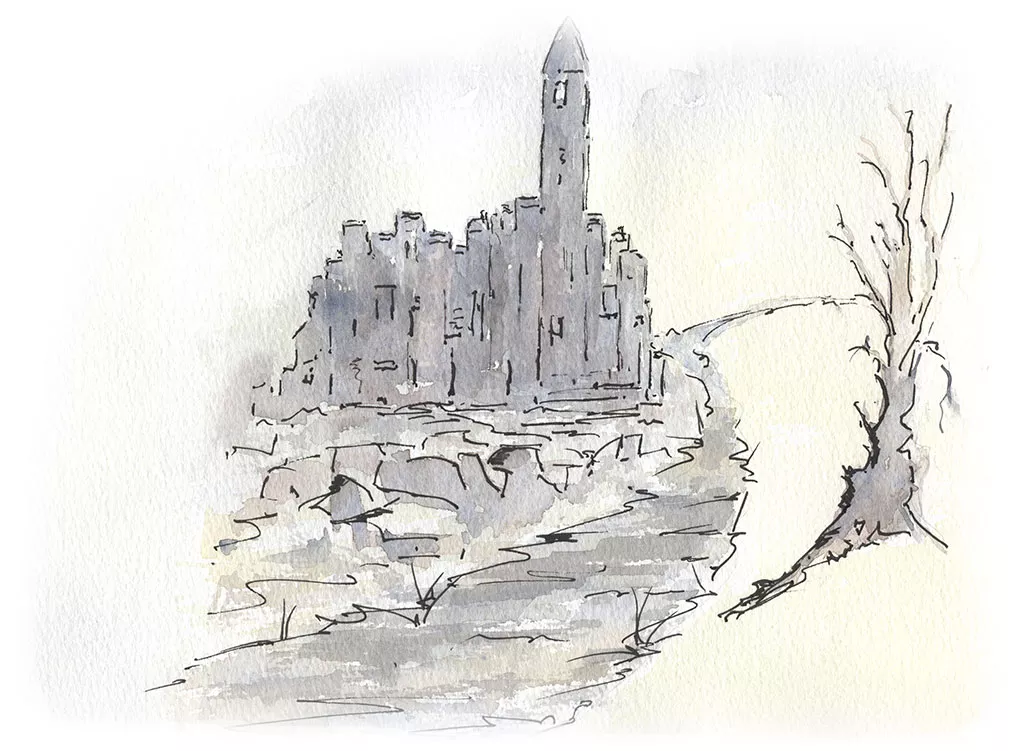
The Janasà are a race of creatures that live high in the mountains of Nuorrù. They are very loosely based on the mythology of the Janas of Sardinia, and Nuorrù is based on the city of Nuoro, which is Sardinia’s third largest city and in the mountainous central eastern part of the island.
In False Tidings, the Janasà are bee-like in their social structures, with a queen at the centre of the colony who is fed royal jelly and is the sole producer of eggs. The few males that exist in their society have only the responsibility of fertilising the queen’s eggs, unlike in bees, where males do have other roles. All females, other than the queen, are thus effectively sisters. I originally had gnomes as the race of creatures that William must confront, but the idea of smiling garden gnomes being evil was too ridiculous, and in any case, the using Sardinia’s actual mythology as a basis for William’s enemies made more sense. The Janasà predominantly live below ground and have evolved bat-like echolocation to find their way around in the darkness. Their ears have evolved into bony nodules that emit and detect sonic waves. They have other adaptations for living deep underground, including suckers on their wrists for clinging onto cave walls and ceilings. Their holy book is called the Janasarium, and the queen makes frequent reference to the scholars who are custodians and interpreters of the book. The Janasarium talks of the human male, the Anointed One, who is, in a prophecy, destined to come to the island and bring the sacred crystal Nuraghù, the so-called Crystal of Life, to them. The crystal hasn’t been seen for many millennia, but at the start of False Tidings, a passageway has opened up deep underground and something glinting in a shaft of sunlight has been spotted by Laddà, a novice member of the Queen’s protectorate. According to the legend of the Butcher Fly, the Janasà cannot touch the crystal themselves, and instead, they are actively searching for their Anointed One to bring it to them. William, of course, is believed to be this messiah-like Anointed One. Protecting the crystal is the two headed cat, Bisgattù, and William has to navigate this terrifying creature deep underground in order to reach the crystal. Nuorrù is a citadel built aeons ago using a lot of neat mathematical calculations. The high towers of the citadel are arranged in a spiral pattern at distances apart, based on the golden ratio (roughly 1:1.61). The bulk of the city is in fact underground, and the different levels of the underground complex also follow the golden ratio. Sacred to the Janasà is a spiral motif, which appears above the gateway into the city and many other places within – for example, the hexagonal sleeping holes that William and friends use have spirals carved above each one. Laddà knows she has found the cavern of the crystal when she finds a spiral pattern etched into the rock wall. William and friends witness the Cutting Ceremony, where the six successful apprentices to the queen’s protectorate are initiated. My original idea was that the smile on a gnome’s face was a hated, inherited feature that he or she would seek to have turned into a frown via cutting. When I switched to basing them on the Janas, I retained the cutting to be something akin to the male circumcision rite of passage that still goes on in many human cultures today. The Janasà are fearsome warriors, but are not, by nature, aggressive toward humans, except when it comes to defending themselves. In Sardonica, the human and Janasà cultures coexist peacefully. However, Queen Nannua of the Janasà acts like any “strong” dictator does in human society, and selects an external enemy [humans] imputing many evil characteristics onto that enemy. It is the fault of humanity that the Janasà are not supreme rulers of the continent. The Queen spreads false tidings (fake news) about the many evil acts perpetrated against Janasà by humans.
William Grey
William Grey is the main character of our story and is in his early twenties when we meet him. He has grown up in a monastery, being the son of the former Abbott, who lost his position as a consequence of getting William’s mother, a woman that did small tasks for the monks, pregnant. William was fortunate that the new Abbott took pity on the family and agreed to allow them to continue living on the monastic estate, and to educate William, an important and unusual thing at the time. William’s mother died in childbirth when he was five years old, and, as his father fell apart with grief, William increasingly was raised by the monks. Shortly before the story starts, William’s father took his own life and left a note to William to “not be like him.” While the monastery is a religious order, it is rooted in a tradition of studying the classics, of natural philosophy (the predecessor to science) and of logic generally. He is schooled in Boolean logic, geometry, algebra and reason in rhetoric. Unfortunately for William, a new Abbott comes who wants to the monastery, he vows to rid the order of its secular influences and return to focus on the sun moon and stars religion of the age. William has to choose between relinquishing his studies in the old logicians and leaving the order. He chooses to leave, and to save as many secular writings as possible. He is a tall, slight man with a fair complexion, a weak beard and blond hair. His dimples and face structure make him surprisingly desirable to women, who perhaps want to mother him rather than mate with him. His schooling and studies have grounded him in the world of reason, and the monks have instilled in him that the idea of magic is a myth to be discounted and ignored. He actively avoids anything opposed to reason, the two most obvious examples being love and magic. Deep down, he knows both exist, but he is afraid of them, because neither can be explained through pure reason. He sets out from the monastery for Ebury, where the new Abbott has secured him the position of apprentice messenger under Lord John Scratchface, a robust member of the nobility. William has a sweetheart that he has known since childhood, a girl a little younger than him called Verity. He believes himself in love with Verity, a beautiful but illiterate member of a serf family, and resolves to make enough of a name for himself to be able to return one day and wed her. As he sets off for Ebury, he feels no particular urgency to this, but will soon need to. He has never so much as held hands with Verity, who in fact is a rather selfish girl, who has so far refused to so much as kiss William. Thus, he heads out into a world, of which he understands little and will have to learn much if he is to survive.
Anthony Ackroyd AKA "The Ant"
Anthony Ackroyd is the chief steward to John Scratchface at the castle in Ebury. He has been in service to the Earl for ten years and served John’s father before that for another twenty. When I first wrote him, I wanted to have the staff give him a nickname, and the contraction Ant fitted the bill well, but was a bit dull. Then I wondered what would happen if he actually resembled an ant, and that’s what ended up in the novel. I think I get away with it. Ant’s father was in service, as was his father before him. Ant’s sisters are all in service also, and we will meet some of them later in the series. Ant has a rather butler-ish locution, perhaps a little like Jeeves in the glorious Wodehouse novels. He is clearly very educated, but as a born commoner, will never rise any higher in his world, a fact that perhaps will rankle with him as the series continues